

You’ve read me harp on and on in FaynWorld’s notes (you do read my notes, don’t you?) about people who learned to play AD&D but didn’t get a grasp on what the books were actually saying. To understand the underlying principles behind the system, you have to actually read the DMG (at least) to grasp the mechanisms which bring the PC from 1st level to whatever level—good play in tandem with some luck will do it.
I’ll confess right up front… I was one of them. It was when I actually sat down and strived to comprehend what EGG was laying out for us in those massive walls of text that the OSR tries mightily to avoid these days, that the subtle currents of what was happening at his table started forming springs to the surface.
I’ve maintained for decades now that the railroady nature of AD&D from about 1986 on started with the Hickmans and Weis through Dragonlance. I never made it beyond the first module of the series, so great was my loathing of “choo-choo” play style ; being told that the actions I took with PCs who were not my creation had to be negated in order to fit with the storyline of the next module genuinely hacked me off.
This weekend I learned of some obscure reference from even earlier than Dragonlance that actually set the ball rolling… no really, I had never heard of this until today, and I’m quite the student of TSR history… the so-called “Hickman Manifesto”. I looked it up during lunch. I have opinions about this.
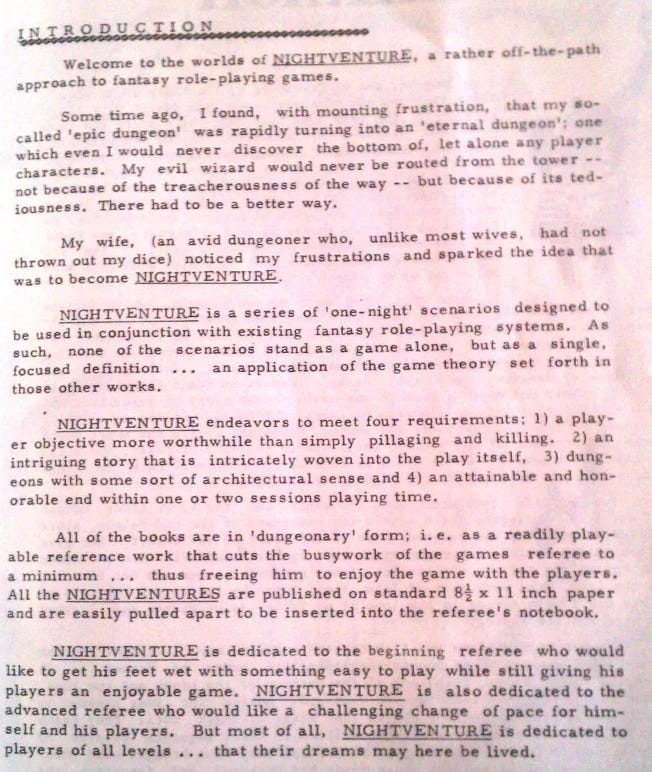
The manifesto outlines four core principles:
A player objective more worthwhile than simply pillaging and killing.
An intriguing story that is intricately woven into the play itself.
Dungeons with some sort of architectural sense.
An attainable and honorable end within one or two sessions of playing time.
Now, I don’t have any problem with any of these per se… in fact, I strongly uphold the first three. But off the top of my head, I suspect these were written in response to the stereotypical “fun house dungeon” of Greyhawk style and the gaming mindset that came from that sort of play. The problem is that Hickman’s solutions completely misunderstood the very AD&D mechanics he was trying to use.
Take that first point: “A player objective more worthwhile than simply pillaging and killing.” I’m hard-pressed to name a TSR module released before 1982 with pillaging and killing as its main objectives. Perhaps Keep On The Borderlands... maybe?… but that was designed by EGG as an intro to the B/X game system for new players. One could say In Search of the Unknown, but that has the same design principle. So I’m guessing Hickman was indeed talking about fun house mega-dungeons. What he missed is that the core mechanic of gold-as-XP wasn’t about mindless killing; it was a mechanical incentive for stealth, reconnaissance, and survival.
Then there’s: “An intriguing story that is intricately woven into the play itself.” I think this is where the conductor shouts “all aboard!” One of the common themes of early TSR modules was dealing with a local threat… hill giants, bandits, strange monsters coming out of a metal door, etc. Hickman seems to state that there should be a story that actually dictates PC action during the course of play. Now, that’s a slippery slope… have a sequence of events unfold regardless of PC actions but can be changed is one thing… corralling the PCs in order to keep the storyline intact is another thing entirely. That’s where Dragonlance comes from…
As for “Dungeons with some sort of architectural sense…” Yeah, I have no problem with that other than it’s a deliberate jab at people who just sit around drawing mega-dungeon maps and then put them on Facebook like a Kindergartner showing his family his latest art work. I know some of those people.
But the real kicker is the fourth principle: “An attainable and honorable end within one or two sessions of playing time.” Well, what do you call a session, Tracy? I come from a background of playing 6-10 hours at a time multiple times a week. EGG ran long games every night. These days, people often limit gaming time to 3-4 hours one night a week. So, that time window sort of varies depending on the players and the DM.
All four of these principles lean toward gaming that wraps up quick and neat, and AD&D doesn’t do that. AD&D is built for campaign continuity, logistics, and long-term survival.
The core mechanics do not promote any of his four points. They simply don’t. They were developed by EGG, RJK and others through “fun house” dungeons. Off shoot adventures like Expedition to the Barrier Peaks don’t wander too far off the main course. It’s Hickman’s works like the Desert series, Ravenloft, and lastly Dragonlance that change players’ perceptions of what the game is truly about. They forced a narrative structure onto a rule set explicitly designed for open sandbox exploration.
When you try to force AD&D to be something it isn’t, the mechanics become a hindrance. Look at the 1990s, when TSR had a boxed set titled Masque of the Red Death. It was a branch off of Ravenloft. Great stuff… basically AD&D set in Victorian London with vampires, golems, Kabbalists, witches, all that stuff… and the AD&D rules were a hindrance to the setting rather than supporting of it. I played it a lot and constantly thought this setting needed its own rules that advanced the detective-like play it demanded.

This is what I do on purpose to your choo-choo modules.
I’d like to go on record here as stating I have never, nor will I ever, develop a fantasy franchise anywhere close to the impact that Dragonlance has had on the fantasy RPG genre. There are modules, books, novels, posters, comics, you name it. There are probably Dragonlance tampons, for all I know. I can’t touch that nor can I impugn it… but I can say that as a player I’ve never given a single damn about Dragonlance. They never made a dime off of me.
If you really want a damned near perfect blend of AD&D hack-n-slash with story telling, something Hickman was describing, then the closest thing would have been the Forgotten Realms. Why?… because the Realms left the core AD&D mechanisms completely intact. It gave you an intricate world to explore without forcing the DM to pull out the conductor’s whistle.
If you don’t actually read the DMG and understand why the mechanics are there, you fall into the trap of thinking the rules are just a clunky vehicle for a pre-written story. They aren’t. They are the engine of the game itself.
I love these deep dives into old manuals. They give me a lot to think about.