

Last week, I gave some interesting examples of how Google Gemini, for example, can be used to create some passable fantasy art with little prompting. I talked about how a content creator, with adequate knowledge of how AI prompts actually work, could probably generate fantasy art on a production scale and at a level of quality no real world artist could match.
As I pointed out, WOTC is doing it although they’ve repeatedly sworn off the stuff like a wino church member. Look for other big companies to follow suit; my guess is Paizo will (though I really hope they don’t) because they’re in a money crunch after getting royally shafted by Diamond Distributors.
Now that I caught your attention last week, here’s my personal opinion on why creators geared toward fantasy works should avoid AI like the plague.
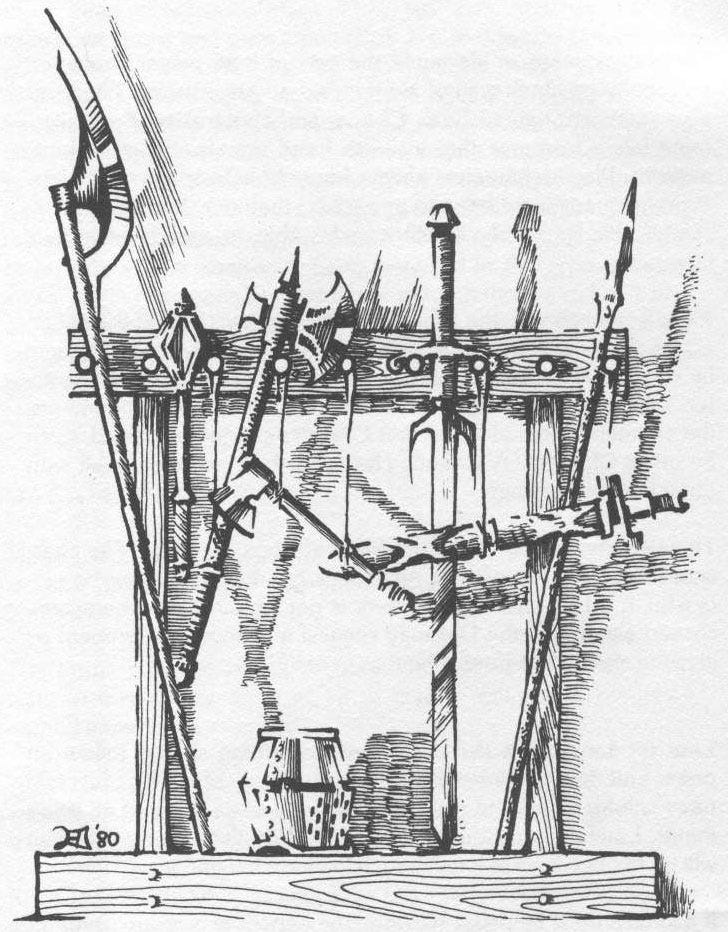
Drawn by Erol Otus
Above is the weapon rack from the Moldvay D&D Basic rule book.
That’s where I started.
Literally.
I originally thought D&D was too weird for me, but that image is the one that forced me to take a closer look at the game.
Drawn by the legendary Erol Otus, it drove home to me a fundamental aspect of D&D and fantasy RPGs in general: you can affect the game world through your actions… in this case through picking up a heavy weapon and defeating something with it and gaining something from that.
Let’s face it: Erol’s art was sort of weird. Nothing looked natural. Everyone had weird helmets and those sock-like boots. You really didn’t want to real world meet up with anyone depicted in his art.
There were other artists with TSR at the time who were technically better (Trampier and Easley come to mind right off). However, Erol Otus had the ability to draw weird scenes and convey the gravity of the situation depicted in a special way that others couldn’t quite meet.
AI can’t do that. AI will never do that, and the reason it never will is because AI cannot create… it can only emulate.
AI art can be technically superior and come out faster, but it will never be able to reach human emotions in the way a human artist can.
Once, there was a professional photographer named William Mortensen. Ever heard of him? No? I’ll bet you’ve heard of Ansel Adams though, right?
The reason you’ve never heard of Mortensen is because Adams hated his guts and got him essentially blackballed. That’s a whole other story.
Mortensen was well known at one time… well known for composing professional images which were subconsciously disturbing. He even wrote a book about his technique for compositing shots titled The Command To Look. It was out of print for decades, but Feral House Press brought it back. If you’re an artist, it’s well worth the read.
Mortensen laid out several aspects of art that instantly capture the attention of the viewer and force emotions upon him.
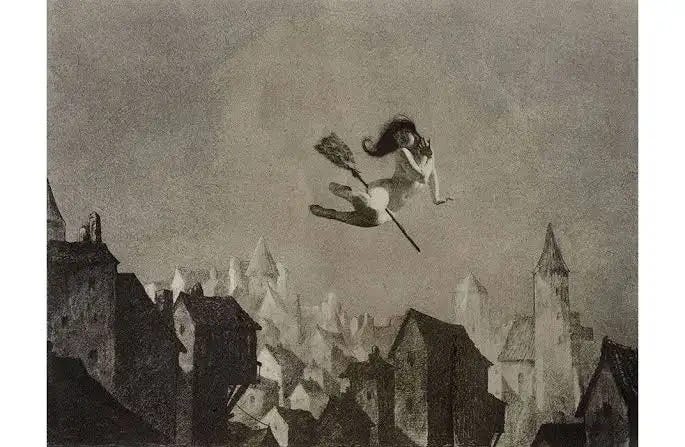
Read the techniques Mortensen used to evoke emotions from his viewers, and see how many you can find in this image.
AI can’t do that. AI cannot create images that reach into the primal emotions of the viewer.
Again, it cannot create, it can only emulate.
And damned few artists can really create, while we’re on the subject. Take a stroll through the ninety gazillion splat books TSR churned out for 2nd Edition AD&D; the art work is, by and large, atrocious and uninspiring… so having a human hand in the creation is no guarantee either.
That crap wasn’t exactly flying off the shelves either; it would sit there for months at a time before Waldenbooks finally sent it back to Random House.
In the end though, as I pointed out last week, fantasy AI art is unfortunately here to stay. It’s here to stay because it must be. Production companies with a lot of money at stake will be forced to churn out more material to market for their customers at an increasing rate (that’s what killed TSR, by the way) and that will call for short cuts.
And short cuts usually wind up being the longest route.
As usual, the comment section is open to anyone who would like to voice their opinions on this subject, so feel free to chime in.
Xeno's paradox comes into play here. He was logically correct but it is irrelevant.
The specific paradox is his argument that you cannot ever actually touch anything. His proof is that before you reach the object you have to cross half the remaining distance, and then half the remaining and again and again, and as distance is infinitely divisible, you cannot ever actually reach your destination, you just get it increasingly close to it. He was proven irrelevant by his opponent kicking a rock.
We know today he is literally correct, the charges of atoms repel each other and if we could actually touch something then there'd likely be some form of reaction, instead two fields repel each other. And yet I stub my toe if I kick a rock.
It is absolutely irrelevant whether or not AI can feel or create. There was a time that no AI art program could draw a full glass of wine, because no such thing existed in their training data. They did only emulate. Today they have caught up to the LLMs and can generate new combinations of pixels that have never been assembled by any human. They can make images that are able to fool an increasingly large percentage of people that it was made by a human. And this is the worst they will ever be. They are only going to get better. Can they actually create something new? Doesn't matter. Just like Xeno.
They can create and they can create images that have an emotional impact on the viewer. And in the end, it is the impact on the viewer, not the intention of the creator that matters.
But this is where the real danger lies. Several conflicting reports have been coming out about the impact of AI on the ability of people to learn and remember. And it's not looking good. Just like using a scooter to get around instead of walking makes your leg muscles atrophy and you get fat, using an AI to do things for you causes your creativity to atrophy and your memory to atrophy, and your dopamine system (the motivation system) to break down.
If you use AI to help you, it's like using weights instead of just doing calisthenics. If you let AI do it for you, it's like using the scooter instead of walking.
You can use AI to help you imagine new scenes and explain ideas. Or you can have it imagine for you. Theatre of the Mind is powerful precisely because every player is engaging in a creative act, making their own version of the scene (see Tolkien's essay "on Fairy Stories" for the best journey down this rabbit hole). Sharing artwork, AI or otherwise, denies that act of creation. Sometimes it's worth it, sometimes not. The temptation is "oh, I can easily prompt to get this image, let me just do that, it's easy". That's the scooter. Don't do it.
The optimal amount of difficulty is not zero. We all know this in gaming because those games get boring. It is also true in creation. Search for the right image and use your words if you can't find it. Don't ride the scooter to a future full of impotence and dementia.