

I touched on this subject in a previous Substack note (you do read my notes, don’t you?), but for those of you too cool to do the homework, I’ll expand on the topic here.
Old school saving throws are a totally different animal from what you get in 3E onward. The latter systems make saving throws rely on the PC’s abilities. 3E devolves the ST system into three categories: Fortitude, Will, and Reflex. Each reflects not a situation for which you must save, but the ability that can affect the save… FORT is affected by CON, WILL is affected by WIS, and REF is affected by DEX.
Okay, mechanics economy. I can dig that.
Here’s the question: if I’m a new player and rolling up my very first PC, if I look at that system… what can I learn from it?
What does this simplistic ST scheme tell me about the dangers I might face later at the table?
Furthermore, since I really don’t know what I’m rolling against, only the bonus I have… how can I gauge my chances of success when my butt is on the line?
The vagueness of the system information here is concerning.
Then we move to 5E (I’m not counting 4E because I don’t know it and apparently few others do either). 5E moves the ST to the abilities themselves; each ability has a ST bonus based on the ability score… so you have STR saves, WIS saves, CHA saves, and so on.
The same vague viewpoint happens again… how can I learn from this system in order to predict what might be coming down the chute at me later on? And how can I gauge my chances of success when I can’t see the goalpost?
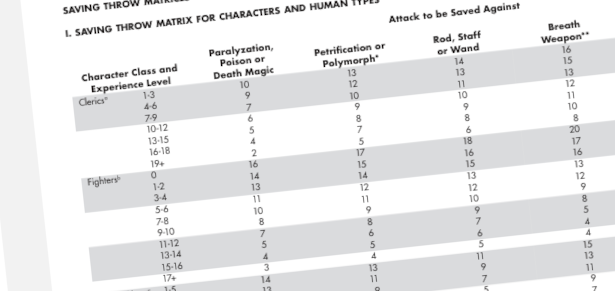
So now we go back and look at 1E (or 2E, if you’re into that candy-assed waste of ink and paper): saving throws get broken into five categories, and those categories tell you exactly what dangers your PC can come across in the process of play. Let’s look at each one in turn:
Paralyzation/Poison/Death Magic: These are effects that act like an off-switch. Fail this and you’re out of action… perhaps permanently.
Petrification/Polymorph: These are effects that fundamentally change your body structure. You’re turned into stone or you suddenly become a snail. Add to that a System Shock roll to see if you can handle being a snail; this is a horrible way to go.
Rod/Staff/Wand: This is your ability to withstand the effects of the spellcaster’s greatest weapons… his personal hand cannon.
Breath Weapon: Generic area attack. Did you dodge just enough to avoid taking the full brunt of that red dragon’s breath, or are you now Mongolian BBQ?
And finally… and perhaps most importantly… Spells: The broad catch-all for resisting the effects of an enemy spellcaster’s spell attack.
Now, I’m that newbie player rolling up my very first PC… I can look at those categories, understand what they mean, and I have a pretty good idea what can happen to Randicore the Thief down in the Dungeons of Doom or wherever I’m heading.
But wait… there’s more:
Each saving throw is defined by a number based on class group and level. For example: a 1st level Fighter has a saving throw against spells of 17. Not good.
A 1st level Cleric or Thief saves vs spells at 15… better but still not great.
A 1st level Magic-user, however, saves vs spells at 12. That’s a lot better.
Why? The fighter doesn’t understand magic; he’s a fighter. The Cleric knows magic when he sees it, while the Thief is naturally cautious about everything; those two have a fighting chance to resist the spell effects. But a magic-user knows magic, even at a beginner level… he can withstand the effects because he can subtly alter them upon contact. Maybe.
These categories of dangers, in tandem with solid numbers to roll against, provide the player with much more information to use tactically when in combat or general play.
I’ve often debated with people about why the save tables aren’t in the Player’s Handbook. My general reply is that they are a game mechanic and so fall under the purview of the DM. In retrospect, I don’t think that argument is solid enough… though it can be mitigated by the knowledge that the player will record the saves, as given by the DM, on his character sheet.
Eh… no system is perfect.