

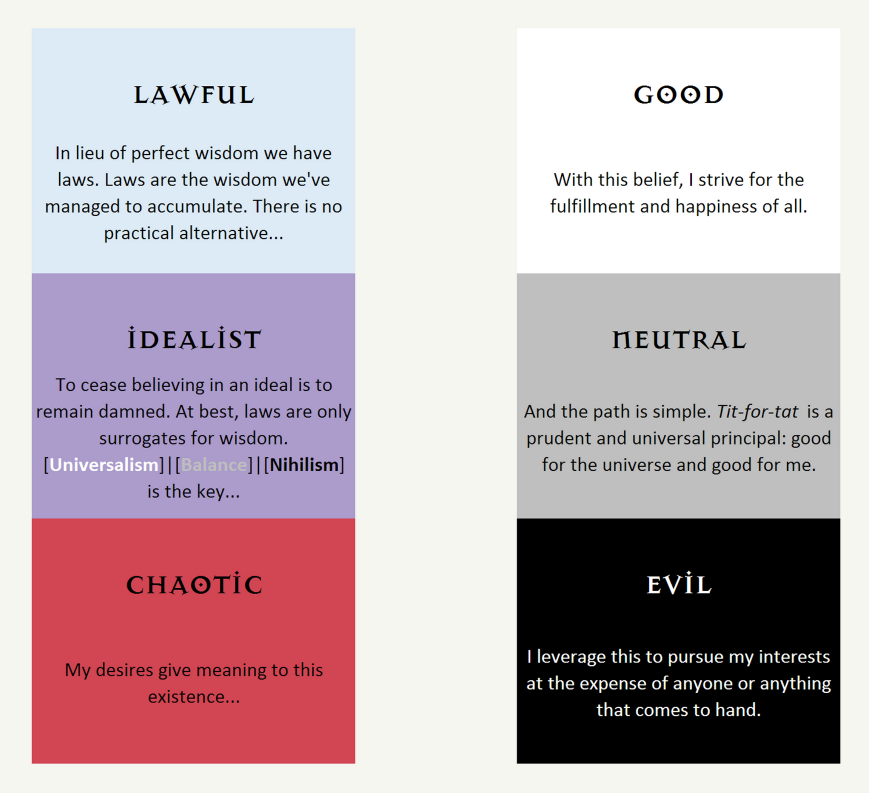
I want to start this by showing you an excellent graphic I blatantly stole from Anthony Huso’s blog The Blue Bard. It’s a must read if you’re into AD&D 1E. Thank you, Anthony.
There’s a trend in modern RPGs to get away from alignment as a game function. Pathfinder 2E Remastered does away with it entirely by assuming a moral compass is relative.
I don’t disagree in principle; a lot of viewpoints are relative, but that’s not how the concept of alignment functions… further cementing my theory that most game designers today don’t understand how D&D in its early form actually worked.
We’ll talk about that over time.
Observe Anthony’s diagram above.
The word alignment implies the PC is pointed toward a certain philosophy, and that begins with the center of his moral universe.
The PC either believes that the laws of civilization should be the guiding principle or that his personal desires and beliefs should be his motivator in life. The neutral PC, or as Anthony calls him… “The Idealist”… realizes that laws are an important replacement for perfect wisdom but can be superseded by an individual’s personal insight, while having no laws to govern personal behavior is being little better than a beast.
That’s the first axis of alignment: is the final authority on life external or internal or a fine balance of both approaches?
Once that’s determined, the PC then decides how he will apply that moral compass in life. The good person wants what’s best for everyone; he might use the laws of civilization to make that happen, or he might believe that individuals can decide for themselves what brings the greatest good.
The evil PC uses his moral compass to enforce his own interests even at the expense of others. He might manipulate and ride civilization’s laws toward his own ends and thus subjugate the weak, or he might believe that “might is right” and prey upon them with impunity.
The neutral or Idealist walks a weird rope; he is pragmatic in his methods to either help others or help himself.
The True Neutral believes that the final answer comes from all angles… the law and the individual’s interpretation of it must be paramount, and the concepts of altruism vs selfishness are just paths one could follow in the pursuit of balance.
Game Application: so how does alignment factor into game play? First, several magic items are oriented toward alignment. The paladin’s Holy Avenger sword is an item with its own LG orientation; it was forged to uphold the laws of civilization and to be used only to help improve the lives of people. That usually means helping the paladin achieve his quests and to destroy evil… especially CE.
Various magical tomes are written with symbolism meaningful only to those of identical alignment; attempting to read those works if one isn’t of that philosophy causes psychological distress and ruptures one’s world view… so they lose experience points.
Interactions around the table and with NPCs hugely depend on alignment. If a paladin tells a group of bandits to either flee the area or they will be killed, they know he’ll keep his word. Spell use often depends on alignment; a LG cleric would loathe to use Cause Critical Wounds because it would be a perversion of his religious beliefs and an affront to his god. Only in the combat and destruction of an evil enemy would he dare use such a spell. Other spells such as Detect Evil and Dispel Evil are tooled specifically to isolate and destroy evil NPCs. They are avenues for the PCs to achieve their in game goals.
Gary Gygax emphasized the DM habit of keeping track of PC alignments… he even provided a cool chart in the PHB to facilitate that. Once a PC drifts too far from his stated world view, he can and will begin to lose powers and experience unless he somehow atones.
I think many modern designers often discard alignment because they see it as restrictive of player’s style… but it was never meant to be a psychological test. Alignment is a philosophical game mechanic that shapes how the world reacts to PC actions.
In future posts I’ll dig deeper into how the 1E system actually worked at the table and why so many modern designers seem to have forgotten it.
Until then please subscribe for these free posts and join us on the paid tier for $5.99 a month where we delve into the lore and mechanics of the occulted demi-plane known as Fayn.