

In the lexicon of classic dungeon design and old-school play, very few tropes are as deeply ingrained as the party thief pressing his ear to a damp, iron-shod wooden door to scout the chamber beyond.
To the modern gamer, this act is often treated as a trivial, risk-free narrative action… a routine perception check before the tactical deployment of that sweet kinetic breach. However, under the Gygaxian architecture of Advanced Dungeons & Dragons 1st Edition, listening at doors is a high-stakes mechanical procedure fraught with potential danger.
Behind this procedure sits a tiny, one-hit-die organism that fundamentally redefined player psychology and underworld pacing:
The Ear Seeker.
Far more than a mere “gotcha” monster, the interplay between the mechanics of listening at doors and the presence of surprise parasites serves as a masterclass in environmental tension and resource management.
The Procedural Engine: Listening at Doors
To understand the dread this creature inspires, one must first look at the exact procedure required to scout a closed portal. This is not a casual narrative request; it is a highly regulated mechanical action governed by distinct rules across the core system.
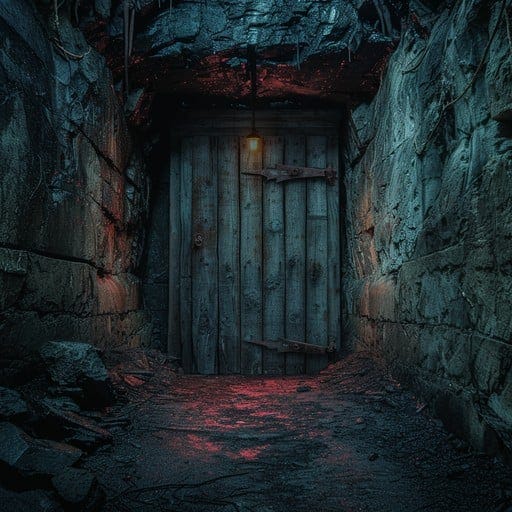
According to the Dungeon Masters Guide (1st Edition), Page 60, under the explicit section heading LISTENING AT DOORS, Gary Gygax establishes how the operation happens for DMs. The text notes that, despite the underlying terrors of the underworld, “most players will insist on having their characters listen at doors at every pretense.”
This action is not some passive skill check. It is an active gamble governed by asymmetric information:
The Non-Thief as a Baseline: For standard characters (Fighters, Clerics, Magic-Users, and their sub-classes), the ability to hear movement, whispering, or scratching beyond a portal is incredibly restricted. DMs resolve this with a flat percentile roll based upon race, made secretly behind the screen to prevent meta-gaming.
The Thief Specialty: The Thief class, however, possesses a distinct mechanical edge in this environment. As outlined in the Players Handbook (1st Edition), Page 28, the Hear Noise column defines a Thief’s specialized percentage chance to detect faint acoustic anomalies. Note that at 1st level, his chances are actually less than the average adventurer unless he holds a racial advantage; at mid-to-higher levels, however, he far outshines the rest.
This disparity exists because the Thief is specifically trained to interpret the subtle, subterranean tells of the underworld. Where an average adventurer might simply suss out that something is there, a skilled Thief can often discern exactly what and how many entities occupy the room beyond.
The critical tactical detail that determines survival is the requirement of silence. To listen effectively, the party must halt their movement, douse loud light sources if necessary to avoid detection through door gaps, and remain entirely still for at least one full turn (10 minutes of game time). This deliberate pause exposes the party to the ticking clock of Wandering Monster checks. Listening is never free; it costs time, and time in a high-lethality dungeon is paid for in blood.
Enter the Parasite: The Ear Seeker Profile
If the time cost of listening at doors is an abstract threat, the physical consequence can be brutal. The dungeon ecology was explicitly designed to actively punish reckless or predictable scouting routines. The primary mechanical countermeasure to the “listen at every door” strategy is found in the Monster Manual (1st Edition), Page 36.
Nestled alphabetically between the “Giant Eagle” and the “Eel,” the Ear Seeker is detailed not as a standard combatant, but as an environmental hazard. Structurally, these creatures are small, insectoid parasites that dwell exclusively in rotting wood, subterranean detritus, and—most notoriously—the damp, unvarnished surfaces of dungeon doors.
Mechanically, the Ear Seeker is almost non-existent in traditional combat terms:
Hit Dice: 1 hit point (not a full hit die, but a single hit point).
Armor Class: 9.
Attacks: None in standard initiative rounds.
A hard sneeze could probably kill one. The horror of the creature lies entirely in its infection vector. When a character presses their ear against an infested wooden door to utilize the mechanics from DMG page 60, there is a flat, unmodifiable chance that 1d4 ear seekers will immediately crawl into the warm, dark environment of the character’s ear canal.
The Brutal Mechanical Resolution
Once infestation occurs, the mechanical trajectory shifts from a dungeon crawl to a horrific medical countdown. The Monster Manual outlines a strict timeline that completely bypasses standard hit point pools and armor class defenses:
Incubation: The creatures lay 9–16 eggs within the ear canal and die shortly after entering. The incubation period lasts a brief 4 to 24 hours, during which the character remains entirely asymptomatic.
Hatching: When the eggs hatch, the larvae immediately begin burrowing inward toward the victim’s brain. Chekhov screams ensue.
The Countdown: The mechanical damage is swift and absolute. The larvae destroy brain tissue rapidly, causing death 90% of the time.
Standard healing magic is completely insufficient to combat this localized cellular destruction. A simple Cure Light Wounds spell will not neutralize parasites lodged deep within the cranial architecture. Only a full Cure Disease spell (a 3rd-level Cleric spell) can destroy the larvae and save the character’s life.

If the party lacks a high-level Cleric capable of casting third-level divine magic, the infestation is a functional death sentence. This structural finality forces players to treat every wooden door not as a simple barrier, but as a potentially lethal contact poison.
The Structural Value of Asymmetric Risk Architecture
By encoding a lethal parasite directly into the primary scouting mechanic of the game, AD&D 1st Edition achieved a specific design goal: the systematic de-escalation of meta-gaming. Because the DM rolls the Hear Noise check secretly, and because Ear Seekers do not cause immediate pain upon entry, players cannot meta-game the results. The player must simply live with the choices their character makes in the dark.
Furthermore, this interplay validates the Thief class. By making door-listening incredibly dangerous for non-specialists, the rules cement the Thief as an indispensable survival asset rather than just a combatant with utility skills.
Finally, it acts as a tool for resource depletion. An Ear Seeker infestation forces the party to expend a valuable, high-level spell slot on Cure Disease rather than offensive or utility magic, systematically grinding down the party’s endurance over a period of time.
The intersection of these specific page references reveals the true genius of Gygaxian design… a system where the environment itself is alive and predatory, and explicitly engineered to kill and eat the adventurers.
Those original rulebooks.. before the storm :)